Friday, May 14, 2010

Delahaye 135 M Coupe by Guillore

Price: 120,517 USD (95,000 EUR)

Year: 1946 Location: Europe
Mileage: 57,500 km (35,729 ml)
Chassis N.: 800597
Colour: Blue
Interior: Blue leather
This 135M coach was designed by Guillore, coach maker in Courbevoie who only worked on Talbot, Delahaye and Delage frames.

The car we offer has only completed 57 500 kms since 1946, the paintwork was completely redone on bare metal 20 years ago, for this, they removed the fenders. The carpets were also changed exactly like Delahaye made them in 1946. The woods are originals and in amazing conditions, they are not dry at all. It runs perfectly, doesn’t heat, the brakes are good and powerful, the doors and the bonnet are completely aligned, the tires are new and it is full matching numbers. The leather is completely original and very well conserved. The second and last owner kept it 25 years and made only 2000 kms with it.

This car is immediately available in Paris with French papers and registration.

Bobrie Type C

Bobrie Type CPrice: Upon request
Year: 1907 Location: Europe
Chassis N.: 16
Colour: Brown
Interior: Black
Incredible 1907 Bobrie Type C in perfect condition.

It is an amazing barn find but the car was never completely abandoned. The patina is superb and the body was never restored. The engine was completely rebuilt with bigger intake valves which allows the car to reach almost 60 km/h, which is really impressive for a 1907 car.

The car is immediately available in France with its French registration.

Jaguar E Type Roadster 4.2 Series 1.5 Fully Restored

Jaguar E Type Roadster 4.2 Series 1.5 Fully RestoredPrice: 98,951 USD (78,000 EUR)
Year: 1968 Location: Europe
Mileage: 840 km (522 ml)
Chassis N.: 34286
Engine N.: 15556

Colour: Blue
Interior: Beige leather
Complete bare metal full restoration, lots of invoices, all numbers matching. Complete set of tools. this beautiful car just drove what is needed to make a perfect set-up after this quality restoration. It is now available in Paris with French papers.

It will be on display during the German car show Techno-Classica in Essen (close to Dusseldorf) from April 7 to 11, 2010 on the stand of CarClassic.com in Hall 12.

AC Cobra 427 CSX3258 all original low original milleage

http://classical-car.blogspot.com/Price: Upon request
Year: 1966 Location: Europe
Mileage: 23,693 km (14,722 ml)
Chassis N.: CSX3258
Colour: Blue
Interior: Black leather
Stunning 1966 Coil spring AC Cobra 427 with only 23 693 km from new .

The car is in perfect working order and shows a very nice patina. Everything is original, with the sole exception of:
- As it recevied 5 or 6 differents coats of various paints all its life, a total bare metal restoration has been completed in France by the sole Shelby approved team, the well known ATS shop in Le Mans, six years ago.
- As mentioned in the 2009 "Shelby Registery": “The original 428 engine was changed by a medium- rise 427 side-oiler, a reverse hood scoop with an opening at the rear edge of the hood, at the sale were the stock parts previously removed from the car.”
It was never involved in any accident and all mechanical elements are the correct period ones. All numbers are marching. It is a part of an important collection and hasn't been driven much. He even entered an historical rally in Morocco. Due to local roads, the paint suffered during this rally and a fanatic would have the car repainted. It is now working fine, but he finally decided a correct 289 is a better choice for historical races, and he doesn't want to loose the patina of such a car.

This car is immediately available for sale in France with French papers.

The owner will consider a part exchange with another very nice 289 Cobra or any other major car.
Please contact us for more details.

And Of Course They Are All Red

 And Of Course They Are All Red Toad Hall kinda started out with a few sports cars housed in a shed behind the Simmons Homestead Inn in Hyannis Port on Cape Cod. Over the past dozen years the number of sheds and cars grew and grew. Finally when there were some three dozen cars, the sheds all got tied together and enclosed. Now there are more than 50 inside and another bunch outside that at least can get driven around. Most are classics from the 50s to the 80s. Most are English, all are red. There are several cars of which less than a dozen are in the States, but the rest simply will bring back happy memories to the older folks. The cars are all nicely restored, and they are all handsome drivers, that is if you can get them out of a now rather crowded garage. The Toad Hall Collection has just been open a year, but everyone who has visited it has had a really great experience. It's now one of the largest collections of Sports Cars in the Country. You just gotta come and check it out. And Of Course They Are All Red


If you remember back in your childhood, or maybe more recently, you probably read the book or saw the Walt Disney movie THE WIND IN THE WILLOWS by Kenneth Grahame, written back in 1908. About a bunch of animal characters in England in the late 1800s. The leading guy was Toad, Lord of Toad Hall. He was totally fascinated by the then new motorcar. And, all of Toad's cars were red too. This same fascination is carried forward today at the Toad Hall Sports Car Museum at the Simmons Homestead Inn in Hyannis Port, Massachusetts, right in the center of Cape Cod.
This collection of classic sports cars is the private collection of Bill Putman, Innkeeper of Sorts at the Simmons Homestead Inn It was just opened up to the public for the first time in 2003. It's open daily from 11 A.M. till 5 P.M. year round. Admission is $8 per adult, big kids from 10 to 16 are $4, and kids under 10 are free if they come with their folks. We will make one exception for bored spouses and only charge them $4, and we have chairs for them while waiting for the car nuts to finish up.
 And Of Course They Are All Red Then there is an added 'benefit' if you are staying as a guest at the Simmons Homestead Inn. You can get in free! Bring a camera if you want. If you are old enough not to rip things off the dashboard, Bill might let you sit in one of them to bring back the old times. This is a place to enjoy.
The cars are all registered and run if you can get them out of the garage. Place has gotten a bit crowded over the years as it grew out of control. Oh well. You can get a preview by going up to the top and clicking on the various marques.

You can also go to the directions page and find out how to get here. Toad Hall and the Simmons Homestead Inn are in Hyannis Port, just outside of Hyannis smack in the middle of Cape Cod.

Also feel free to call us at 1-508-778-4934 or e-mail us at ToadHallCars@aol.com Toad Hall Sports Car Museum is a great place to spend some time and really enjoy these classic red little critters.

Porsche 911 Carrera 3.2 Speedster narrow body and low original mileage

Porsche 911 Carrera 3.2 Speedster narrow body and low original mileageBeautiful 1989 Porsche 911 3.2 Speedster with narrow body (1 of 165).

This car has 3 owners from new and a very low mileage (32.000 km). Delivered new in silver with black leather interior. The second owner decided to paint it in “Gulf” blue and he re-trimmed the interior in dark red leather. All the restoration work was made by Bentley in Monaco and the dark red leather comes from Porsche.

This catalyzed model of 911 develops 217 HP and comes with optional electrical seats.

This car is immediately available in France with its complete sets of books and tools.

Monday, April 26, 2010

Porsche 930 Turbo 33 Targa Boite 5 vitesses - 5 speed gearbox

Porsche 930 Turbo 3.3 Targa Boite 5 vitesses - 5 speed gearboxStunning Porsche 930 Turbo Targa with the very desirable 5 speed gearbox. It is the rarest of all 930 Turbo with only 193 units produced from 87 to 89 and even less with the 5 speed transmission.

This unit has been delivered new to Japan and has always been perfectly maintained. It is currently is superb condition, showing only 51.000 Km on the clock. The paint is superb and the light grey leather interior is faultless. It is a superb car, in a stunning condition.

The 930 Turbo is already a collector. The 1989 version is the most sought after with the 5 speed transmission. The Targa is the rarest. It is thus an excellent opportunity to purchase one of the only 193 930 Turbo Targa ever built, and with a clear history.
This superb Porsche is available in Japan. The price includes the shipping cost for any european country, and all european or swiss taxes paid.

BMW Z8

BMW Z8The BMW Z8 was produced from 1999 to 2003. It was given the E52 BMW model code.
The Z8 was the production variant of the 1997 Z07 concept car, which was designed by Henrik Fisker at BMW's Designworks USA in Southern California. The Z07 originally was designed as a styling exercise intended to evoke and celebrate the 1956-'59 BMW 507. The Z07 caused a sensation at the '97 Tokyo Auto Show. The overwhelming popularity of the concept spurred BMW's decision to produce a limited production model called the Z8. There were 5,703 Z8s built, approximately half of which were exported to the United States.

The car we are proud to offer has only 11.000 kilometers from new and was always very well maintained. It has been delivered new in Japan and has only had 2 owners. This car is really pleasant to drive and the 4.9l V8 from de M5 E39 is really powerful. It is currently in immaculate condition.

It is immediately available in Japan. The price includes all european or swiss taxes as well as shipping in any european country.

AC Cobra 427 SC - CSX4000 Continuation by Shelby - Aluminium

AC Cobra 427 SC - CSX4000 Continuation by Shelby - AluminiumThe Shelby Cobra is probably one of the most iconic sports car of all time. It has been the dream of many enthusiasts through the years, and is still today one of the most desirable cars. Carroll Shelby, the famous Texan race driver and tuner, had found the magic recipe by fitting powerful Ford V8 engine in the small AC roadster. The most extreme version, the 427 will be fitted a monstruous 7 Liters Ford V8 rated at 425 HP. Enough to make the Shelby Cobra 427 one of the fastest car on Earth, even today.

As an icon, the Shelby Cobra has been one the most copied car in the world. Everything has been seen on this special market, the best replicas and more often the worst cars have been built by many small firms all over the world. In the late 90's, Shelby, the creator of the legendary Cobra, decided to produce a series of CSX4000 continutation Cobra, with VIN following the one's of the last genuine cobras made in the sixties which were carrying CSX3000 VIN.
These CSX4000 Cobra are of course everything the 65 models were and even more. They are built on a 65 like chassis but much stronger. Other enhancements have been made, like a better cooling system, a modern gearbox, enhanced suspensions (built like the original ones), and a better steering.

The car we are proud to offer is a Cobra 427 S/C built by Shelby. It is one of the rare ones to have been ordered with an all aluminium body like the original Cobra. the engine is an all aluminium Shelby 427 dynoed at 515 HP. The gearbox is the 4 speed Toploader. The car is currently in like new condition having been driven only 300 miles from new.

As a Shelby, the car is registered as a 1965 with an original VIN, and is delivered with an extensive file provided by Shelby, including a manufacturer's statement of origin, certifying the car is 1965. This is trully unique in the Cobra world, as only the CSX4000 are delivered with a COC, a VIN compliant with the original ones, and can thus be registered in Europe (including France) as 1965 Shelby Cobra.

If there were only one Cobra to buy today, except the original ones whose prices are far below 500.000 EUR, it would be the CSX4000 continuation. This is the only one to be fully compliant with the original one, with original registration and VIN, and for a competitive price compared to replicas. With the alumiunium body it is the closest thing to the original Cobra. And as a Shelby built cobra, the car is listed in the Shelby registry.

This stunning cobra is available in the USA. The price includes shipping to any european country as well as all european or swiss taxes paid. For our french customers, the car will be delivered with a french standard carte grise as a 1965 427 Shelby Cobra.

Porsche 911 - 993 RSR 1 Of 45

Porsche 911 -  993 RSR 1 Of 45Beautiful 1989 Porsche 911 3.2 Speedster with narrow body (1 of 165).
This car has 3 owners from new and a very low mileage (32.000 km). Delivered new in silver with black leather interior. The second owner decided to paint it in “Gulf” blue and he re-trimmed the interior in dark red leather. All the restoration work was made by Bentley in Monaco and the dark red leather comes from Porsche.
This catalyzed model of 911 develops 217 HP and comes with optional electrical seats.
This car is immediately available in France with its complete sets of books and tools.

Saturday, April 24, 2010

The Original Impala SS

The Original Impala SS At the dawn of the 1960's, Kennedy, the new President-elect, spoke of a "new frontier." He was talking of new age of post-war prosperity and specifically, America's quest for reaching the Moon. For the big three, the new frontier was one of technical and marketing innovations. Combining the two became an essential element in the

Wednesday, April 21, 2010

Why Are Dollectible?

Why Are  Dollectible?Number matching cars are collectible because they are much rarer than non-number matching cars. Number matching cars represent a look back in history at what was occurring in the automobile industry, and it may be for this reason that matching numbers are tied to collector car values.


How Does Number Matching Work?

How Does Number Matching Work?The numbers or casting dates on the major components of a car must be present and fall in a particular order. For example, an engine’s assembly date must come before the build date of the car, and the casting dates must come before the assembly date of the engine because an engine assembly date (the date the engine was assembled, usually at a different location) could not be after the assembly date of the whole car. Engines are assembled prior to being installed in the car at the factory. Therefore, the assembly date of the car would have to be after the assembly date of the engine. Casting dates (the dates formed in the metal of a component at the foundry) could not be after the assembly date of the engine. And casting dates would need to be well in advance of the assembly date of the engine. Numbers and dates help track an accurate history of how a car was built and when and where the car and the parts used to create the car were made.

If a car has number matching major components it helps define how collectible a car is. Number matching cars typically will have a much greater value than non-number matching cars.

Minor Components

Minor ComponentsMinor components are components that would not dramatically affect the overall value of a car, regardless of being original or not. These are parts that are commonly replaced due to regular wear and tear. Parts such as the interior fabric, paint, chrome trim, brakes, instruments, electrical components and wiring are considered minor components.

Major Components

Major ComponentsThe car's major not maching components are parts such as the engine, transmission, rear-axle assembly, and frame of the car. Many times these components contain dates, casting numbers, model numbers, VIN, stamped numbers, or codes that can match the original components that were on the car when it was new. In some cases intake manifolds, exhaust manifolds, body panels, and carburettors could also be considered major components.

Definition

DefinitionThe term "number matching" (or "matching numbers") is a term used in the collector car industry to describe the authenticity of collectible or investment quality cars. Number matching generally means that a particular car still contains its original major components or has major components that match exactly the major components the car had when it was new. These "major components" are not always agreed on. The appearance of a number matching car likely could not distinguished from an original car. A site by the name numbermatching.com (direct link removed since Firefox reports this site as "suspicious." Visit at own risk) has established a standard of specifications for a common definition of "number matching" and can certify them according to their company's definition.

Number Matching

Number MatchingNumber matching or matching numbers is a term often used in the collector car industry to describe cars with original major components, or major components that match one another.

Many times these major components contain dates, casting numbers, model numbers, Vehicle Identification Numbers (VIN), stamped numbers, or codes that can match the original components that were on the car when it was new.

Vintage Car

Vintage CarA vintage car is commonly defined as a car built between the start of 1919 and the end of 1930. There is little debate about the start date of the vintage period—the end of World War I is a nicely defined marker there—but the end date is a matter of a little more debate. The British definition is strict about 1930 being the cut-off, while some American sources prefer 1925 since it is the pre-classic car period as defined by the Classic Car Club of America. Others see the classic period as overlapping the vintage period, especially since the vintage designation covers all vehicles produced in the period while the official classic definition does not, only including high-end vehicles of the period. Some consider the start of World War II to be the end date of the vintage period.

The vintage period in the automotive world was a time of transition. The car started off in 1919 as still something of a rarity, and ended up, in 1930, well on the way towards ubiquity. In fact, automobile production at the end of this period was not matched again until the 1950s. In the intervening years, most industrialised states built nationwide road systems with the result that, towards the end of the period, the ability to negotiate unpaved roads was no longer a prime consideration of automotive design.

Cars became much more practical, convenient and comfortable during this period. Car heating was introduced, as was the in-car radio. Antifreeze was introduced, allowing water-cooled cars to be used year-round. Four-wheel braking from a common foot pedal was introduced, as was the use of hydraulically actuated brakes. Power steering was also an innovation of this era. Towards the end of the vintage era, the system of octane rating of fuel was introduced, allowing comparison between fuels.

During this period, as well as the car adapting, society began to adapt to the car. In the United States, drive-in restaurants were introduced as well as suburban shopping centers and motels.

Brass Era Car

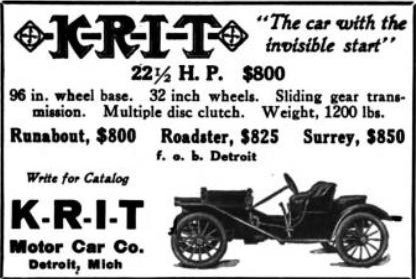
Brass Era CarThe automotive Brass Era is the first period of automotive manufacturing, named for the prominent brass fittings used during this time for such things as lights and radiators. It extends from the first commercial automobiles marketed in the 1890s until about World War I. The term "Brass Era automobile" is a retronym for "horseless carriage," the original name for such vehicles, which is still in use today. The Brass Era closely followed the Veteran Era.

Within the 15 years that make up this era, the various experimental designs and alternate power systems would be marginalised. Although the modern touring car had been invented earlier, it was not until Panhard et Levassor's Système Panhard was widely licensed and adopted that recognisable and standardised automobiles were created. This system specified front-engined, rear-wheel drive internal combustion engined cars with a sliding gear transmission. Traditional coach-style vehicles were rapidly abandoned, and buckboard runabouts lost favour with the introduction of tonneaus and other less-expensive touring bodies.

Throughout this era, development of automotive technology was rapid, due in part to hundreds of small manufacturers competing to gain the world's attention. Key developments included the electric ignition system (by dynamotor on the Arnold in 1898,[1] though Robert Bosch, 1903, tends to get the credit), independent suspension (actually conceived by Bollée in 1873), and four-wheel brakes (by the Arrol-Johnston Company of Scotland in 1909). Leaf springs were widely used for suspension, though many other systems were still in use, with angle steel taking over from armored wood as the frame material of choice. Transmissions and throttle controls were widely adopted, allowing a variety of cruising speeds, though vehicles generally still had discrete speed settings, rather than the infinitely variable system familiar in cars of later eras. Safety glass also made its debut, patented by John Wood in England in 1905. (It would not become standard equipment until 1926, on a Rickenbacker.)
Between 1907 and 1912 in the United States, the high-wheel motor buggy (resembling the horse buggy of before 1900) was in its heyday, with over seventy-five makers including Holsman (Chicago), IHC (Chicago), and Sears (which sold via catalog); the high-wheeler would be killed by the Model T. In 1912, Hupp (in the U.S., supplied by Hale & Irwin) and BSA (in the UK) pioneered the use of all-steel bodies, joined in 1914 by Dodge (who produced Model T bodies). While it would be another two decades before all-steel bodies would be standard, the change would mean improved supplies of superior-quality wood for furniture makers.

Value

ValueAs with all collectibles (antiques), current value has everything to do with current supply vs. demand, and very little else: certainly little to do with the car's price when new or any objective standard. Thus, rare cars that are highly desired are highly expensive, while vehicles that are not fashionable to collect can be very cheap. Condition, of course, influences value. At the present time, the variation in purchase price between a poor condition and good condition vehicle is generally much less than the cost of restoring a poor condition car; thus it is cheaper in the long run to buy the better vehicle.

In some instances, professional restorers can, through economy of scale and performing the work in-house, realise a profit from buying an unrestored car and performing a restoration. This is normally only possible when the car is in high demand and either very rare (e.g. old Ferraris) or quite common (e.g. classic Ford Mustangs). Amateur restorers who are highly skilled may find it cheaper to restore than buy in good condition, but this is through considering their labor as enjoyment rather than as a cost. Some body shops make huge profits from doing restorations while business is slow to keep their workers busy.

Realising much long-term profit in owning an antique car is mostly about attempting to anticipate future changes in taste, which is highly speculative. Most cars go through a period of being considered merely old and undesirable before becoming valuable, and a car bought then might drastically increase in value. However, a car is a large object that is expensive to store and must be maintained, which cuts into profits.